
August 17, 2026 · 9 min read
After Effects Carpet Cleaning
How Long Does Carpet Take to Dry After Cleaning?
Carpet cleaned with truck-mounted hot water extraction is usually dry in 4 to 8 hours. On a humid Jersey Shore day in a closed-up house it runs 8 to 12. A rental machine leaves most of its water in the pad and can take 12 to 24 hours or longer.
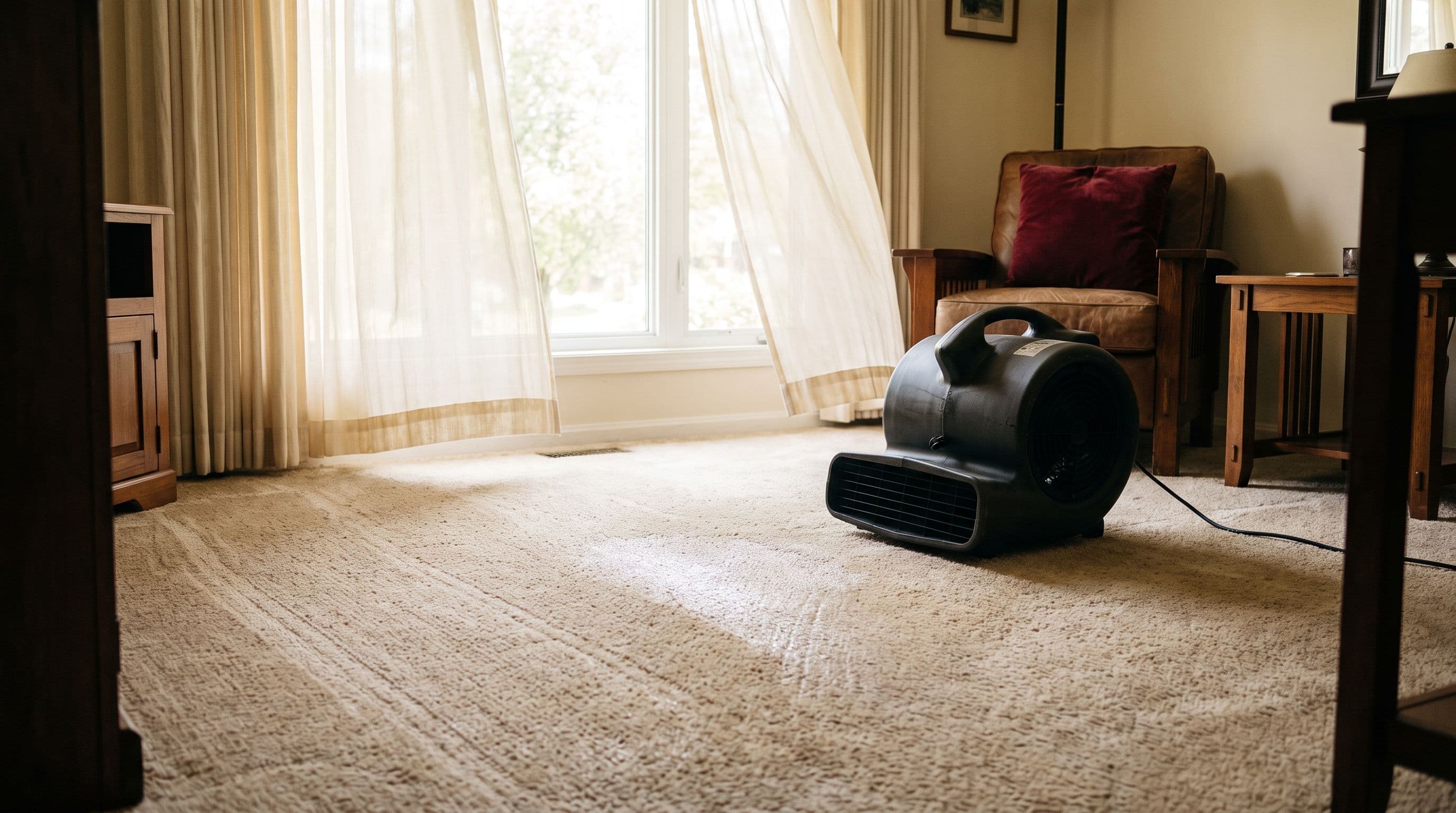
How long does carpet take to dry after cleaning?
Four to eight hours in most of the homes we clean, and that is the number we give people standing in their living room. (Updated August 2026.) That range is not a brochure figure. It is what a truck-mounted hot water extraction job actually does in a normal Ocean County house with a fan running and the air conditioning on. Four hours is a low-pile carpet in a breezy room in October. Eight hours is a thick plush over a heavy pad in a shut-up house in August. Both are normal.
Nobody can hand you one number, because drying is not something the cleaning does to the carpet. It is something the air does to it afterward, on its own schedule. Our part ends when the wand comes off the floor. What happens over the next several hours is decided by how much water is left in the pile and the pad, how much air crosses it, and how much moisture that air is already carrying.
So here is the honest range across a season of shore work. Truck-mounted extraction with good airflow and moderate humidity: 4 to 6 hours. Truck-mounted extraction on a thick plush, or on a humid August day with the house closed up: 8 to 12 hours. A rental or portable machine on the same carpet: 12 to 24 hours, and we have walked into second-day-damp carpet in Waretown and Toms River more times than we can count. Low-moisture encapsulation: 1 to 2 hours, but it only cleans the top of the pile, so you are trading depth for speed.
If a cleaner quotes a flat two hours on a whole house without asking about your pile, your pad or your air conditioning, be a little skeptical. That is a best case being handed to you as a promise.
What decides how long carpet takes to dry?
Four things decide it, and only one of them is the carpet: how much water stayed behind after the cleaning, what is underneath the carpet, how much air crosses the surface, and how much more moisture the room air can absorb. Everything else hangs off one of those four.
Pile height and density. A dense plush or shag holds far more water per square foot than a low-pile Berber, and holds it deeper in the yarn where air does not reach. On the same job, the plush bedroom will still be damp when the low-pile hallway is dry.
The pad underneath. This is the part you never see and the part that usually decides the number. A thick, high-density pad is a sponge, and the only way out is up through the carpet into the room air. That is why the last of the drying is always the slowest part.
The method, which really means recovery. Getting a carpet wet is easy; every machine does that. What separates them is how much comes back up in the same pass. Our truck-mounted system recovers the large majority of what it puts down into a tank on the van, so the carpet we leave is damp, not saturated.
Airflow across the surface. Moving air is what pulls moisture off the fiber. Still air saturates right above the carpet and stops accepting water. An air mover angled low across the pile does more for dry time than the thermostat ever will, which is why we set air movers before we leave rather than telling you to hope.
Humidity, which at the shore is the big one. Carpet dries by giving water to the air, and air near its capacity cannot take much more. A 55 percent day and an 85 percent day are two different jobs with identical carpet in them.
Room temperature, secondary but real. Warm air holds more moisture than cool air, so 74 degrees beats 65, as long as the air is actually moving. Heat with no airflow just makes a warm damp room.
How does truck-mounted extraction compare to a rental machine on drying time?
The gap is roughly three times, and it is decided by recovery, not by heat, chemistry or brand. Here is the comparison the way we would give it at your kitchen table.
Truck-mounted hot water extraction. What it leaves behind: carpet damp to the touch, with most of the water and the soil in a recovery tank on the truck. Typical dry time: 4 to 8 hours, at the long end on a humid shore day. Why: the vacuum comes off the machine on the van, not a household motor, so it lifts water back out of the pile and the top of the pad in the same stroke that puts it in.
Grocery-store rental machine. What it leaves behind: a wet pile, a wet pad, and the detergent it could not flush. Typical dry time: 12 to 24 hours, into a second day in a humid house. Why: it sprays with real pressure and recovers with shop-vacuum suction, so most of that water stays in your floor and has to evaporate on its own.
Low-moisture encapsulation. What it leaves behind: a barely damp pile and a polymer that crystallizes around the soil to be vacuumed later. Typical dry time: 1 to 2 hours. Why: almost no water goes down, so almost none has to come back out. The tradeoff is that nothing is flushed, so deep soil, sand at the backing and anything in the pad stays put.
Read that back and the pattern is obvious: dry time tracks recovery, and recovery is the same thing that decides whether the carpet is actually clean. That is one machine capability showing up twice. A cleaning that leaves your carpet wet for a day and a half left the dirty water in your floor too, and as that water finally evaporates upward it can carry dissolved stain back to the surface with it.
Why is a humid Jersey Shore August the hardest drying week of the year?
Because the air out here in August is already carrying nearly all the water it can hold, so your carpet has nowhere to send its moisture. Between Barnegat, Waretown, Manahawkin, the LBI corridor, Toms River and Brick we sit on a bay with the ocean behind it, and from late June into September the dew point barely drops overnight. A carpet that dries in four hours here in October takes eight or nine in mid-August with nothing else changed.
Lagoon and bayfront homes have it worse than houses a mile inland. Salt air holds moisture, slabs and crawl spaces stay cool and damp, and a house that sat empty all week has stagnant, saturated air in every room before we knock. Add the shore soil load (sand worked down to the backing all summer, salt residue that pulls moisture out of the air on its own) and August carpet is both the dirtiest and the slowest-drying of the year.
Rental turnovers are the tightest version of it. Guests out at ten, next family in at three, is not a drying window, it is a deadline. When somebody calls us with that clock we say so up front: either a very early slot with air movers running the whole gap, or a different method for that job. What we will not do is promise a soaked plush will be walkable in four hours on an 85 percent humidity Saturday.
One counterintuitive piece saves people real hours, and we say it on every summer job: keep the windows shut and run the air conditioning. Everyone's instinct with a wet carpet is to throw the windows open, and from October through May that instinct is right. In August it is backwards: if the air outside is more humid than the air inside, open windows hand your carpet a worse partner to dry against. Air conditioning cools and pulls water out of the air at the same time, which is exactly what a drying carpet needs.
How can you speed up carpet drying in the first two hours?
The first two hours matter more than the rest of the day combined, because that is when the pile holds the most free water and moving air can take the most of it. Do these six things and you will routinely pull hours off the number:
1. Leave the air movers where we set them. We place them low and angled across the carpet, not pointed straight down, because the goal is a sheet of air skimming the fiber. Turning one to face another room undoes most of what it was doing.
2. Run the air conditioning and keep the windows closed if it is humid outside. In shore-summer conditions the AC is a dehumidifier you already own. In cool, dry weather, flip it and open the windows.
3. Turn the ceiling fans on and leave them on. They do not dry carpet directly, but they keep the humid layer sitting above the pile moving off and getting replaced instead of sitting there saturated.
4. Set the HVAC fan to on, not auto. On auto it only moves air while the system is actively cooling. Set to on, it circulates the whole house all afternoon, which is free drying you already paid for.
5. Leave interior doors open. A closed bedroom becomes its own sealed humid box, and it is almost always the last room in the house to dry.
6. Keep off it, and keep everything else off it. Foot traffic mats damp pile and drives surface moisture back toward the backing, and any furniture leg or box on damp carpet blocks airflow and holds that patch wet for hours.
One thing not on the list: cranking the heat. Hot still air is not drying air. A room at 90 degrees with no air movement dries slower than a room at 72 with a fan across the floor. Airflow first, temperature second.
When can you walk on it, move the furniture back, and put the rugs down?
Those are three different clocks, and lumping them together is how people undo a good cleaning. Careful walking is fine right away, normal use waits until the carpet is dry to the touch, furniture waits until the whole floor is dry, and anything that seals the carpet off waits a full day.
1. Right away, carefully, in clean socks or shoe covers. Damp carpet is not fragile. What you are avoiding is tracking soil from a driveway or hard floor onto fibers that are open and wet, because they will grab it and hold it.
2. Normal foot traffic once it is dry to the touch, typically 4 to 8 hours. Press the back of your hand into the pile in the middle of a room, not by a wall or a vent. Cool and clammy means it is still working; neutral and dry means you are clear.
3. Furniture back once the whole room is dry, usually 8 to 12 hours, at the long end in shore-summer humidity. Leave the foam blocks or plastic tabs under the legs until then. Wood legs on damp carpet can bleed stain into the fiber, and metal glides and casters can leave rust marks that are genuinely hard to reverse.
4. Area rugs, runners, plastic sheeting and moving blankets after a full 24 hours. This is the one people rush and the one that causes real damage. Anything laid over carpet that is not completely dry seals moisture underneath it, and a dry-to-the-touch pile can still sit on a pad holding water.
Stairs are their own case. They get hand-detailed, so they take more solution per square foot and hold moisture in the nose of each tread, and damp stair carpet in socks is slippery. Use the handrail and wear shoes with grip until the treads are dry.
When does slow drying become a real problem, and what does it smell like?
Past 24 hours, still-damp carpet stops being an inconvenience and becomes a microbial problem, and you will smell it before you see it. The smell is flat, sour and earthy, like a wet basement or a towel left in a gym bag. It is not the cleaning products and it is not pet odor. It is the pad staying wet long enough for mildew to get started, and it can show up within a day or two of the cleaning that caused it.
The tell is where and when. Musty from slow drying shows up across the whole cleaned area and arrives right after the job. Returning pet odor comes back in the exact footprint of the old accidents and gets stronger on humid days, because uric-acid salts left in the pad reactivate when they pull moisture out of the air. Three different problems, three different fixes, so know which one you have before you spray anything.
This is also the honest argument against the cheap version of the job. A rental that leaves a pad soaked in a bay-humid August is slow, and worse, it sets up the smell. Water left in your floor is the source of both failure modes at once: the musty smell in the short run, and stain wicking back to the surface as the pad finally dries in the long run.
If you are past 24 hours and still damp, do not wait it out. Get air movers on it, put a dehumidifier in the room if you have one, close the windows and run the AC, and pull up anything sitting on the carpet so air reaches the whole surface. Still damp at 48 hours, or already smelling, means the water reached the pad and needs to be pulled back out rather than waited out. That is a call, not a project.
Want your carpet dry the same day?
Drying time is not luck and it is not the weather's fault. It is recovery on the truck, air movers on the floor, and a straight answer about what your carpet and your house are going to do. After Effects Carpet Cleaning is owner-operated, based in Barnegat and working the whole Ocean County shore (Waretown and Manahawkin, down the LBI corridor, up through Toms River, Brick and Lakewood) plus the Monmouth and Mercer County towns on the service-areas pages. Every carpet cleaning job includes the air-mover step and a real dry-time estimate for your rooms before we start, and we will tell you honestly if your window is too tight for the method your carpet needs. Get a free estimate through the contact form, or call or text us at 609-342-3183.
Related reading:
Want it done right the first time?
After Effects restores carpets and floors across Ocean County and the Shore. Send a photo and get a free, firm quote at your door.
Quick answers
People also ask.
Plan on 8 to 12 hours instead of the usual 4 to 8. Carpet dries by giving its moisture to the air, and humid Jersey Shore air is already close to capacity, so evaporation slows down. Running the air conditioning with the windows closed helps more than anything else, because the AC pulls water out of the room air while it cools.
Yes, carefully, in clean socks or shoe covers. Damp carpet is not fragile, but wet fibers grab soil easily, so what you want to avoid is tracking grit in from a driveway or hard floor. Wait until the carpet is dry to the touch, typically 4 to 8 hours, before normal foot traffic, and take the stairs slowly because damp treads are slippery in socks.
Almost always because the machine put down more water than it recovered, so the pad underneath is saturated and has to evaporate everything on its own. Rental and portable units run household-vacuum suction and routinely leave carpet wet for 12 to 24 hours or more. Still air and high humidity stretch it further. Past 24 hours, get air movers on it and run a dehumidifier or the air conditioning, because a pad that stays wet is how a musty smell starts.
Only when the air outside is drier than the air inside. In cool weather, open windows help a lot. In a humid shore summer, open windows bring moisture in and slow the carpet down. From roughly June through September the better move is windows closed, air conditioning running, ceiling fans on and the HVAC fan set to on rather than auto.
Until the whole room is dry, usually 8 to 12 hours and longer in humid weather. Leave the foam blocks or plastic tabs under the furniture legs until then. Wood legs sitting on damp carpet can bleed stain into the fiber and metal glides and casters can leave rust marks, and both are far harder to remove than they were to prevent.
A flat, sour, wet-basement smell means moisture is sitting in the pad with no airflow reaching it, and mildew is getting started. It shows up across the whole cleaned area rather than in one spot, which is what separates it from returning pet odor. Increase airflow immediately, close the windows and run the AC or a dehumidifier, and lift anything sitting on the carpet. If it is still damp at 48 hours, the water needs to be extracted, not waited out.
Keep reading
How to Deep Clean Luxury Vinyl Plank Floors
Dry soil first, a barely damp mop with a neutral cleaner, and never a steam mop. Why LVP goes cloudy, what damages it at the shore, and how we clean it.
Can You Take an Area Rug Somewhere to Be Cleaned?
We clean area rugs in your home, not at a depot. What in-place cleaning reaches, which rugs genuinely need a plant wash instead, and what is going on with the floor underneath.