
August 3, 2026 · 9 min read
By Peter De Leon, After Effects Carpet Cleaning
Steam Cleaning vs Dry Carpet Cleaning: Which One Do You Need?
Steam cleaning vs dry carpet cleaning comes down to soil depth and dry time. Truck-mounted hot water extraction, what most people call steam cleaning, flushes embedded soil out of the pile and dries in 4 to 8 hours. Low-moisture encapsulation dries in 1 to 2 hours but leaves the deep soil where it is.
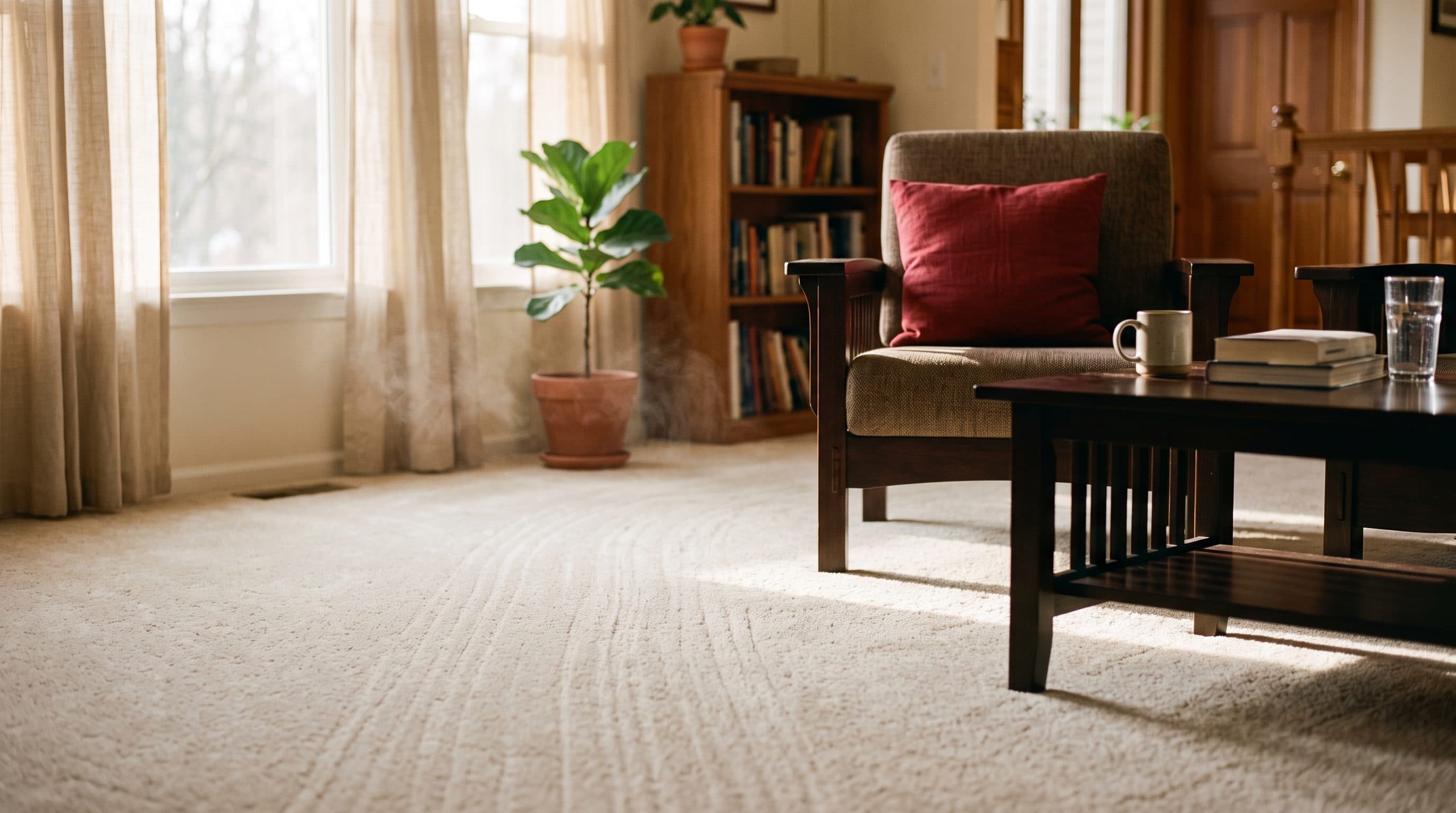
What does hot water extraction actually do to a carpet fiber?
It heats water far past what any rental machine can hold, injects it into the pile under pressure, and vacuums it straight back out in the same pass, so the soil leaves the house instead of getting pushed deeper into it. (Updated August 2026.) That is the whole mechanism, and the name most people use for it is a little off. There is no steam at the carpet. It is very hot water and very strong vacuum working together, and the trade name for it is hot water extraction.
Here is what happens down at the fiber. Soil in a carpet is not just dust. It is a mix of dry grit, body oils, food residue, and whatever came in on shoes, and the oily part is the glue that holds the dry part onto the fiber. Heat breaks that bond. Hot water softens the oil film so it lets go, the pre-spray chemistry loosens what is left, and the pressurized rinse lifts it into suspension in the water. Then the vacuum on the truck, which is in a different class from anything that runs off a wall outlet, pulls that dirty water back up through the pile and into a recovery tank on the van. Nothing is left sitting in the carpet to dry back into it.
The part that decides the whole job, and the part a rental machine gets wrong, is that recovery. Getting a carpet wet is easy. Getting the water back out is the entire trick. When I run the truck-mount in Barnegat or Manahawkin, the carpet is damp to the touch when I leave, not soaked, because the machine takes back the large majority of what it puts down. That recovery is also why extraction reaches the base of the pile and the top of the pad, which is where the soil that makes a carpet look gray actually lives.
What do low-moisture and encapsulation methods do differently?
They clean with chemistry instead of water volume, then let a vacuum finish the job later. Low-moisture cleaning, sold as dry cleaning, dry compound cleaning, or encapsulation depending on the product, uses a small fraction of the water an extraction uses. The most common version is encapsulation. A polymer solution is spread over the carpet and worked into the pile with a rotary or cylindrical brush machine. The polymer surrounds each soil particle, and as it dries it crystallizes around that particle into a brittle shell that cannot bond back to the fiber. Then you vacuum, either the same day or on the next regular pass, and the encapsulated soil comes up dry.
The dry compound version runs on the same idea with a different carrier. A slightly damp absorbent compound, essentially treated granules the texture of fine sawdust, gets brushed into the pile, absorbs soil while it sits, and gets vacuumed out. Bonnet cleaning is the third cousin in that family: solution goes down and an absorbent pad is spun over the carpet on a rotary machine to wipe soil off the top of the pile. Bonnet is fast, and it has a legitimate place as interim maintenance on commercial carpet, but it only touches the top third of the fiber and the spinning pad can fuzz the yarn on cut-pile residential carpet.
The honest limitation of every low-moisture method is the same one: it cleans what it can reach, and it cannot reach the bottom. There is no flush and no recovery, so whatever is sitting at the base of the pile or down in the pad stays there. That is not a defect, it is a design tradeoff, and it was a deliberate one. These methods were built for commercial glue-down carpet in offices that cannot be closed overnight, and for that job they are genuinely good. On a shore house carrying a summer of sand, they are the wrong tool for the problem.
Why does dry time decide steam cleaning vs dry carpet cleaning at the shore?
Because in a humid bay-air house wet carpet is its own problem, and because half the calls I take have a deadline attached. Twenty minutes inland, dry time is a convenience question. In Barnegat, Waretown, or a lagoon house in Silverton, it is a mildew question, since bay humidity slows evaporation and a carpet that would be dry in four hours in October can take eight in August. Put that in a summer rental where guests check out at ten and the next family pulls in at three, and dry time stops being a preference and becomes the thing that picks the method for you.
Here is the honest comparison, laid out the way I would say it standing in your living room.
Truck-mounted hot water extraction. How it works: heated solution injected into the pile under pressure and vacuumed back out in the same pass. Typical dry time: 4 to 8 hours, at the long end on a humid shore day. Best for: embedded soil, gray traffic lanes, pet urine, sand and salt, allergens, and any carpet you want cleaned down to the base of the pile.
Encapsulation, low moisture. How it works: a polymer solution is brushed into the pile, crystallizes around each soil particle as it dries, and is vacuumed out afterward. Typical dry time: 1 to 2 hours. Best for: light to moderate surface soil, commercial glue-down carpet, interim cleaning between deep cleans, and rooms that cannot be taken out of service.
Dry compound. How it works: an absorbent granular compound is brushed into the pile, absorbs soil as it sits, and is vacuumed out. Typical dry time: effectively none, the carpet is walkable right away. Best for: light soil and moisture-sensitive situations where no added water at all is the requirement.
Bonnet. How it works: solution is applied and an absorbent pad is spun over the carpet to wipe soil off the top of the pile. Typical dry time: under an hour. Best for: interim maintenance on commercial carpet. It is not what I would put on a cut-pile residential carpet.
Read that table twice and the decision rule falls out of it on its own. If the problem is on the surface and the clock is the constraint, low moisture wins. If the problem is in the carpet and you want it gone, extraction wins, and the 4 to 8 hours is what it costs you. The mistake is picking the fast method for a deep problem, because then you have paid for a cleaning and still own the problem.
Which method handles traffic lanes, pet accidents, salt and sand?
Extraction, on all four, and it is not a close call, because every one of those problems lives below the surface and below the surface is exactly where a low-moisture method does not go. Here is how each one actually behaves:
Traffic lanes. The gray path from the door to the couch is oily soil bonded to the fiber plus fine grit driven down toward the backing. Encapsulation lifts the top layer, the lane looks better for a few weeks, and then the grit still sitting in the base works its way back up. Extraction flushes both out in the same pass.
Pet urine. Urine passes through the carpet into the pad and sometimes the subfloor, and it dries into crystallized uric-acid salts. No amount of polymer on the surface reaches a salt deposit in the cushion. It takes an enzyme pre-treatment to break the salts down and hot water sub-surface extraction to flush them out, which is the whole subject of my guide on getting dog and cat urine out of carpet for good.
Beach sand. Sand is heavier than house dust, so it sinks to the carpet backing, and it is hard angular quartz that cuts the fiber like sandpaper every time somebody crosses the room. A brush-and-vacuum method agitates the top of the pile. It does not pull sand off the backing. Heat and real suction do.
Salt residue. Salt from bay water and salt air dries into crystals in the fiber that pull moisture out of the air and leave the carpet stiff and whitish. The only way to remove salt is to dissolve it back into water and then extract that water. There is no dry method for salt, because a dry method has nothing to dissolve it into.
That list is most of what a shore carpet actually deals with, and it is why the van is built around extraction first. There is a version of this job where low moisture is the right call, and I get to it below, but a family house in Ocean County in August is usually not it.
What does your carpet warranty say about the cleaning method?
Read it before you choose, because plenty of residential carpet warranties name professional hot water extraction specifically and put a schedule on it. Manufacturers write that in for a straightforward reason: extraction removes soil rather than relocating it, and abrasive soil left in the pile is the thing that wears carpet out years early. The common wording asks for professional cleaning by a qualified operator on a set interval, usually somewhere in the 12 to 24 month range, and asks you to hang onto the receipt.
Two things trip people up here. The first is assuming any professional cleaning satisfies the requirement. Some warranties are specific about the method, and a bonnet or dry-compound cleaning may not count even though a company took your money for it. The second is throwing out the invoice. If you ever file a claim, those receipts are the proof, and no receipt usually means no claim. Check your own paperwork, or the manufacturer's website if the paperwork is long gone, before you assume anything.
If your carpet is newer and still covered, that one document often settles the steam cleaning vs dry carpet cleaning question before anything else in this article does. Use the method the warranty asks for. My part is simple enough: every job gets an itemized invoice that says what was actually done, so you have the record if you ever need it.
What do we use at After Effects, and when do we switch?
Truck-mounted hot water extraction is the default on every residential job, and I switch to a low-moisture method when water is the wrong answer for that particular floor. I am one owner-operator running one van out of Barnegat, and I am not going to pretend a single method is right for everything. But for a shore house with sand, pets, kids and bay humidity in it, extraction is the right answer the large majority of the time.
Here is the order a normal extraction job runs, so you know exactly what you are buying:
1. Walk the rooms with you. I identify the fiber, find the traffic lanes and the trouble spots, and quote the firm price before a hose comes off the truck.
2. Dry vacuum first. Loose grit and beach sand come out dry, because anything lifted before water goes down is soil that never gets a chance to turn to mud.
3. Pre-spray and let it dwell. An eco-friendly, non-toxic pre-treatment breaks the bond between soil and fiber, pet areas get a targeted enzyme treatment, and both get time to work.
4. Agitate. The pre-spray gets worked down into the pile so it reaches the base of the fiber instead of sitting on top of it.
5. Extract. Heated solution goes in under pressure and comes straight back out with the soil in it, into the recovery tank on the truck.
6. Groom and set the dry time. I rake the pile so it dries standing upright, then tell you how to move air through the room and roughly when you can walk on it.
The switch to low moisture happens on a short and specific list: commercial carpet in an office that cannot be shut down, a glue-down that has to stay in service, an interim freshen-up between real cleanings, or a moisture-sensitive situation where I do not want water anywhere near a subfloor. It is a real tool and it does real work in its lane. What I will not do is run a fast surface method over a carpet with a deep problem, call it clean, and let you find out three weeks later. If the honest answer is that your carpet needs extraction and you need a rental turned over in two hours, then the conversation we should be having is about scheduling, not about method.
Not sure which method your carpet needs?
Tell me what the floor actually deals with, sand, dogs, kids, a rental calendar, and I will tell you which method I would run and why, at the door, before you owe anything. I am Peter De Leon, owner-operator of After Effects Carpet Cleaning, based in Barnegat and working the whole Ocean County shore, from Waretown and Manahawkin down the LBI corridor and up through Toms River, Brick and Lakewood, plus the Monmouth and Mercer County towns on the service-areas pages. There is no travel charge anywhere on the route. Send a photo of the carpet, get a free estimate through the contact form, or call or text me at 609-342-3183.
Related reading:
Want it done right the first time?
After Effects has restored carpets and floors across the Shore for over 30 years. Send a photo and get a free, firm quote at your door.
Quick answers
People also ask.
In practice, yes. What the industry calls hot water extraction is what almost everyone else calls steam cleaning, and it is the method truck-mounted systems run. The name is technically wrong, since no steam reaches the carpet. It is very hot water injected under pressure and vacuumed straight back out, and that vacuum recovery is what separates it from every low-moisture method.
Truck-mounted hot water extraction typically leaves carpet dry in 4 to 8 hours, at the long end on a humid shore day. Encapsulation runs about 1 to 2 hours. Dry compound is walkable essentially right away, and bonnet cleaning is usually under an hour. Airflow, humidity and pile thickness move all of those numbers, so a fan and the HVAC running will shorten any of them.
It is better when the only constraint is the clock and the carpet is only lightly soiled between guests. It is the wrong choice when the carpet has a season of sand, salt or pet accidents in it, because a low-moisture method cannot reach the base of the pile or the pad. For a real turnover carpet, the better answer is usually to schedule the extraction for the gap between bookings rather than downgrade the method.
It genuinely cleans, within its limits. The polymer crystallizes around each soil particle so the particle cannot bond back to the fiber, and vacuuming then removes it. What it does not do is flush anything, so soil sitting at the base of the pile or in the pad is untouched. That is why encapsulation works well as interim maintenance on commercial carpet and falls short as the only cleaning a heavily used residential carpet ever gets.
Many residential carpet warranties specify professional hot water extraction by name, on an interval usually in the 12 to 24 month range, and require you to keep the receipts. Some are specific enough that a bonnet or dry-compound cleaning may not satisfy the requirement. If your carpet is still under warranty, read the document first, because it can settle the method question before anything else does.
Yes, and sometimes that is the right plan. A common one is extraction on the living areas, stairs and pet zones where the soil is deep, with a low-moisture method reserved for a room that has to stay usable or a moisture-sensitive area. The point is matching the method to the problem in each room rather than running one method everywhere because it is faster to set up.
Keep reading
Refinish or Replace Hardwood Floors: How to Read Yours
Refinish or replace hardwood floors? The answer is one measurement: the wood left above the tongue. How to read yours before you pay for a new floor.

The Letter on Your Couch Tag Decides How It Can Be Cleaned
Upholstery cleaning codes on the fabric tag, W, S, WS and X, decide whether your sofa takes water, solvent only, or vacuuming alone. Here is each one.